Employees are the most valuable asset of any company or organization.Protecting them is not only…

Industrial Gas Detector Cost? The Complete Guide: How to save 70% ,Install and Maintain
So how can you save up to 70% in costs?
In most gas detection systems on the market today, installation costs are very high.
Why?
Because each sensor and detector is connected directly to the control panel (see left image).
With this setup, you typically need:
- At least 2 wires for power
- And at least 2 wires for communication
That means a minimum of 4 wires per detector going back to the control panel.
Is there another way?
Yes — absolutely.
In an addressable system (see right image), all detectors are connected in a chain using just one 2-wire cable.
- No need to run separate power to each detector
- No need to connect every detector directly to the panel
A much simpler approach — with significantly lower installation costs.

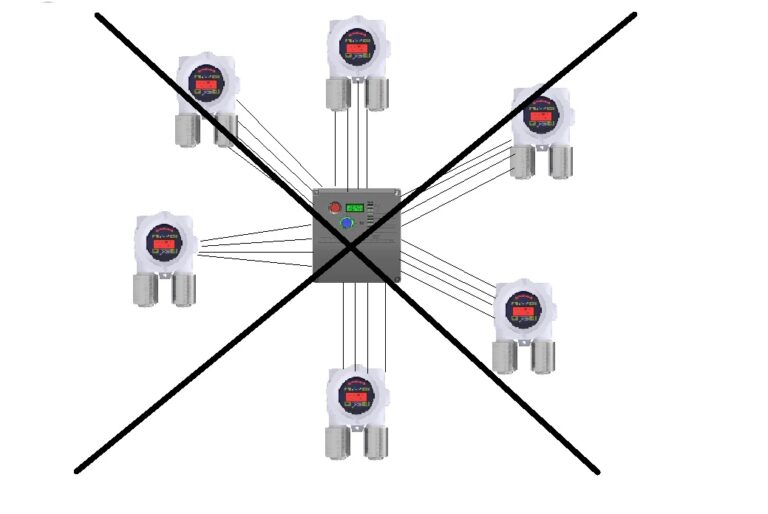
Connecting detectors to a control panel — not anymore
What are the advantages of connecting detectors in a chain?
- Less wiring = lower cost
- Faster installation — no need to connect each detector directly to the panel
- No need for separate power infrastructure — saving both material and labor costs
Think about it:
If you have 5, 10, 20, or even 30 detectors —
how much wiring and installation time can you save?
- Only the control panel needs power (230V or 24V)
- All detectors are connected using a 2-wire shielded cable
- Cable length can reach 1 km or more
With this approach, you can reduce both equipment and installation costs by up to 70% or more.
How does this work in practice?
What if you need to monitor two different gases, where:
- One is lighter than air, and
- One is heavier than air?
Example:
LPG (heavy gas) and Hydrogen (light gas)
Normally, you would need two separate detectors:
- One for hydrogen
- One for LPG
With most systems, that means buying and installing two units.
But it doesn’t have to be that way.
With this solution, you only need one detector:
- An LPG sensor installed about 15 cm (6 inches) above the floor
- A hydrogen sensor connected externally to the same detector and installed near the ceiling
Because hydrogen rises and LPG settles — each sensor is placed exactly where it should be.

Introducing the industrial (explosion-proof) gas detector
Model TOC-903-X5 — a closer look
Is this just another gas detector like many others on the market?
The answer is — no. But you can decide for yourself:
What makes this detector different?
- Can hold 2 sensors — measure two different gases at the same time
- Can operate as a standalone gas detector
- Can connect to an addressable gas detection system
- Each sensor has 3 alarm levels (ALARM 1 / 2 / 3)
- Capable of monitoring up to 400 different gases
What can it detect?
- Flammable gases
- Toxic gases
- Oxygen deficiency (O₂)
- Volatile Organic Compounds (VOC)
- Refrigerant gas leaks
A short demonstration movie:

What types of gases can be detected?
Toxic gases
Sensors are available for a wide range of toxic gases, including:
Ammonia, Chlorine, Nitrogen Oxides, Carbon Monoxide, Carbon Dioxide, Hydrogen Chloride, Silane, Sulphur Oxides, and more.
Examples:
- Boron Trichloride: 0–10 ppm
- Carbon Monoxide: 0–100 ppm / 0–2,000 ppm
- Carbon Dioxide: 0–5,000 ppm / 0–5% VOL / 0–100% VOL
- Hydrogen Sulphide: 0–50 ppm / 0–5,000 ppm
- Hydrogen Chloride: 0–10 ppm
- Nitric Oxide: 0–100 ppm
- Nitrogen Dioxide: 0–20 ppm
- Silane: 0–10 ppm
- Sulphur Dioxide: 0–5 ppm
- Formaldehyde: 0–5 ppm
- Carbon Disulphide: 0–100 ppm
- Ethylene Oxide: 0–10 ppm / 0–100 ppm
- Sulphur Hexafluoride: 0–1,000 ppm
Flammable / explosive gases
- LPG (propane/butane)
- Hydrogen
- Methane
- Acetylene
- And many more
Examples:
- Hydrogen: 0–1,000 ppm
- IR (Infrared): 0–100% LEL
- IR Methane: 0–100% VOL
- Pellistor (MK8): 0–100% LEL
- Acetylene: 0–200 ppm
VOC (Volatile Organic Compounds)
- Detection of a wide range of organic vapors and solvents
Oxygen (O₂)
- Oxygen deficiency monitoring: 0–25%
Ammonia & Refrigerant gases
- Infrared: 0–2,000 ppm
- Refrigerants (R1 group): 0–1,000 ppm
- Refrigerants (R2 group): 1,000–10,000 ppm
Ammonia (NH₃):
- 0–100 ppm
- 0–500 ppm
- 0–5,000 ppm
Where and how should the detector be installed?
The detector can be installed in a wide range of industrial environments, such as:
- Production areas
- Storage facilities
- Laboratories
- Near gas cylinders
- Industrial plants
- Gas storage tanks
Because the detector is ATEX certified, it can also be installed in hazardous (explosive) areas such as Zone 21 & 22.
Installation basics
- Requires only 2 screws for wall mounting
- Must use the explosion-proof cable glands supplied with the detector
- Using standard connectors will void the explosion-proof protection
Installation configurations
The detector can be installed in several ways:
- As a standalone detector
- Connected to a gas control panel (addressable system)
- With an external remote sensor
Wiring
- Connection to the control panel is done באמצעות shielded 2-wire cable
- Shielding protects communication from electromagnetic interference
Standalone operation
Need just one detector? No problem.
- Each detector operates independently
- Powered by 24V supply
- Can include 1 or 2 sensors (measure two gases simultaneously)
Outputs & integration
- Each sensor has a separate channel
- Analog output: 4–20 mA (for connection to control systems, fire panels, or BMS)
- Relay output (dry contact / SSR)
- Can be used to activate external alarms (e.g., siren + beacon) for nearby workers
How do you know when a gas leak is detected?
The detector features a color digital display that changes based on the gas condition:
- Green – Normal condition
No gas leak detected, system is operating properly - Red – Gas leak detected
The display immediately turns red when gas is detected
(If connected, external devices such as a warning light and siren will also activate) - Orange – Fault condition
Indicates a system fault or issue that requires attention


What if the detector is installed far away (even 1 km or more)?
If the detector is located far from the operator, maintenance staff, or control room, we recommend using a “Room Indicator”.
This device provides a continuous indication of the system status — even from long distances.
Status indication:
- Green – Normal, no gas leak
- Red – Gas leak detected
Additional option
You can also connect a cellular dialer, which will:
- Send an SMS alert
- Call up to 3 predefined phone numbers
Do you need to connect the detector to a controller?
Not necessarily.
The detector can operate as a standalone unit for local alarm indication.
However, if you need to monitor multiple gases across different locations, you can connect all detectors into a central control panel.
- Connection is done using a 2-wire cable
- All detectors are linked together in one system
Why connect detectors to a control panel?
- View real-time readings from all detectors in one place
- Easily adjust alarm levels remotely (no need to access each detector)
- Manage the system via user interface (Wi-Fi communication)
- Integrate with other systems via MODBUS RS485
- Built-in audible alarm for immediate notification
- During an alarm:
- The screen turns red
- Displays the detector number in alarm
Available control panels
- TOC-635 – Gas controller
- TOC-635 PLUS – Supports up to 32 detectors
- TOC-750 – Supports up to 128 addressable detectors
Frequently Asked Questions
How should the detector be maintained?
After installation, it is recommended to perform a bump test using calibration gas to ensure proper response to gas leaks.
Do detectors require calibration?
All detectors are supplied pre-calibrated and ready to use.
When should calibration be performed?
Calibration frequency depends on the sensor type:
- Flammable gases – every 6 months
- Most toxic gases – once a year
- Special / exotic gases – every 3 months
We will guide you on the correct calibration schedule and how to extend sensor life.
Where can detectors be calibrated?
We provide periodic calibration services for all types of detectors.
Who can you contact for support?
We offer full technical support before and after installation.
You can contact us directly and get immediate assistance.
Who performs the installation?
We are happy to handle the installation, but you can also use:
- Your own maintenance staff
- A qualified electrician
We will support you throughout the process and can assist on-site if needed.
How will you learn to operate the system?
We provide free training for every system or detector purchased.
What if your team has changed and no one knows the system?
No problem.
We can schedule a short training session:
- On-site
- Or remotely via video call
Related Posts