Optimizing Biogas Power Generation Through Accurate Gas Analysis Across the world, wastewater treatment plants and…

Everything You Need to Know About Oxygen Detectors: Types, Key Differences, Pros & Cons
Are All Oxygen Detectors the Same?
The answer is no.
Not all oxygen detectors are created equal. While many devices are designed to measure oxygen concentration, there are significant differences between them that can greatly affect their performance, reliability, and suitability for specific applications.
Some of the key differences include:
- Sensor lifespan
- Sensor technology
- Country of manufacture
- Portable vs. fixed detectors
- Indoor vs. outdoor installation
- Compliance with industry standards and certifications
- Price range
- Intended applications and operating environments
However, the most important factor is choosing the detector that best matches your specific application and operational requirements.
How Do You Choose the Right Oxygen Detector?
This comprehensive guide will walk you through the different types of oxygen detectors available on the market. We’ll compare their technologies, explain their advantages and disadvantages, and discuss the applications for which each type is best suited.
By the end of this guide, you’ll have a much clearer understanding of which oxygen detector is the right choice for your facility.
Why Is This So Important?
It is entirely possible to select a detector that appears to be the right choice because of its price, physical size, or sensor technology—and still end up with the wrong solution.
Choosing the wrong oxygen detector can result in unreliable monitoring, delayed hazard detection, increased maintenance costs, or even compromise personnel safety.
Selecting the right detector is not just about buying an instrument—it’s about ensuring accurate monitoring, regulatory compliance, and protecting lives.
Step-by-Step Guide to Choosing the Right Oxygen Detector
Selecting the right oxygen detector is about much more than choosing a brand or comparing prices. It starts with understanding your application and the type of hazard you need to monitor.
Follow these steps to make the right choice.
Step 1 – Decide Whether You Need a Portable or Fixed Oxygen Detector
The first and most important question is:
Do you need a portable detector to protect personnel, or a fixed detector to continuously monitor a specific area?
Portable Oxygen Detectors
Portable oxygen detectors are designed to protect workers while they perform their daily tasks. They are intended to be worn throughout the entire work shift, typically clipped to the worker’s clothing within the breathing zone.
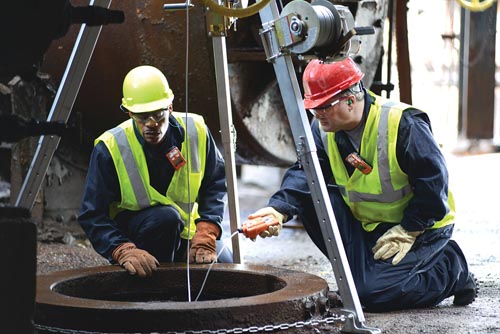
One of the most common applications for portable oxygen detectors is confined space entry, where oxygen levels must be continuously monitored before and during entry to ensure a safe working environment.
Another advantage of portable detectors is their flexibility. They can easily be placed in a room, inside a fume hood, or at a temporary work location and then moved to another area whenever needed.
For example, the PDM+ Portable Oxygen Detector is capable of operating continuously for up to three years without requiring battery replacement or recharging, making it virtually maintenance-free and always ready for use.
Fixed Oxygen Detectors
Fixed oxygen detectors are designed for continuous monitoring of a specific location. They are permanently mounted on a wall or other structure and provide 24/7 protection.
As a general guideline, a single fixed detector can effectively monitor an area with approximately a 5-meter (16-foot) radius, which is roughly equivalent to a room of 70 m² (750 ft²), depending on airflow and room layout.
To obtain accurate measurements, the detector should typically be installed within the breathing zone, approximately 1.2 to 1.8 meters (4 to 6 feet) above the floor, unless the application requires a different mounting height.
Step 2 – Are You Monitoring for Oxygen Deficiency?
If the answer is yes, selecting the proper measurement range is critical.
The oxygen sensor should have a measurement range of at least 0–25% oxygen, allowing it to accurately detect both normal oxygen concentrations and oxygen-deficient conditions.
According to widely accepted safety standards, the low oxygen alarm should be set at 19.5% O₂, which is considered the minimum safe oxygen concentration for personnel. This alarm level applies to both portable and fixed oxygen detectors.
For fixed monitoring systems, such as the TOC-750B, alarm activation is typically provided through dry-contact relay outputs (NO/NC), allowing the detector to trigger audible alarms, visual beacons, ventilation systems, emergency shutdowns, or integration with building management and safety control systems.
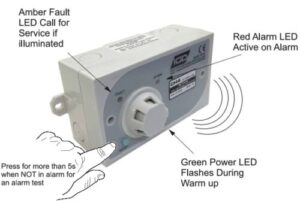
Oxygen deficiency monitor model TOC-750BAV-O2
It is essential that the detector provides both visual and audible alarms to ensure personnel are immediately alerted to hazardous oxygen levels.
A visual alarm should include a high-intensity flashing red LED, while the audible alarm should be integrated into the detector itself, as found in the TOC-750BAV Oxygen Monitor.
The TOC-750BAV also features two dry-contact relay outputs (NO/NC), allowing independent activation of Low Oxygen and High Oxygen alarm conditions.
These relay outputs are particularly valuable because they allow the detector to interface with external safety systems, including:
- Fire alarm systems
- Building Management Systems (BMS)
- PLC and industrial control systems
- Ventilation or exhaust systems
- Emergency shutdown systems
Another important feature to verify is the ability to connect an external horn/strobe alarm.
In most installations, the horn/strobe is mounted outside the monitored room. This provides personnel with a clear visual and audible warning before entering the area, allowing them to immediately determine whether oxygen levels are safe or if an alarm condition exists.
Providing this warning outside the room significantly improves safety by helping prevent personnel from unknowingly entering an oxygen-deficient or oxygen-enriched environment.
.
Need to Install More Than One Oxygen Detector?
If your facility requires multiple oxygen detectors, consider using our revolutionary 2-wire addressable system.
Unlike conventional systems that require extensive field wiring, our innovative 2-wire technology simplifies installation by allowing multiple detectors to communicate over a single two-wire network. This reduces installation time, lowers wiring costs, and makes future expansion fast and easy.
Whether you’re monitoring several rooms, an entire laboratory, a manufacturing facility, or a large industrial site, our addressable system provides a scalable, reliable, and cost-effective solution for centralized oxygen monitoring and alarm management.
When your facility requires multiple gas or oxygen detectors, installation complexity and wiring costs can quickly become a challenge. That’s exactly why we developed our 2-Wire Addressable Gas Detection System—a smarter, faster, and more cost-effective solution for modern gas detection. Our system combines an intelligent gas controller with a wide range of compatible gas detectors, all connected using just two wires. Unlike conventional gas detection systems, our technology does not require a separate power supply for each detector. The same two-wire cable provides both: This dramatically simplifies installation while improving overall system reliability. For installations with up to 32 detectors, we recommend the Model 635 Addressable Gas Controller. The controller is typically installed in the control room, while all detectors are connected in a simple daisy-chain configuration. Unlike traditional systems, each detector does not need to be individually wired back to the controller. Instead, every detector shares the same two-wire communication loop, resulting in substantial savings in installation time, labor, and cable costs. One of the biggest advantages of our addressable technology is its intelligent digital communication. Each detector continuously communicates its exact status to the controller, allowing the system to accurately distinguish between real gas events, detector faults, and communication issues. The result is an exceptionally reliable system with virtually no false alarms, giving operators greater confidence and reducing unnecessary downtime. To see how our revolutionary technology works, watch this short demonstration: Installation is significantly faster than conventional gas detection systems, reducing labor hours and cable requirements. There is no need to run separate power wiring to each detector. The same two-wire cable delivers both power and digital communication. All detectors are connected on a single communication loop instead of individually returning to the controller. This greatly reduces installation complexity. A single controller can communicate with up to 128 addressable gas detectors, allowing the system to grow with your facility. Different gas detector types can operate on the same network. Whether monitoring oxygen, combustible gases, toxic gases, refrigerants, or specialty gases, every detector connects using the same simple two-wire cable. Every newly connected detector is automatically recognized by the controller. The system identifies the detector type, configures the correct alarm parameters, and makes the detector operational without manual programming. Once installed, the system operates automatically without requiring complicated configuration or routine adjustments. Thanks to the simplicity of the 2-Wire Addressable Technology, installation costs can be reduced by up to 80% compared to conventional gas detection systems. Adding or removing a detector is incredibly simple. Connect the new detector anywhere on the existing two-wire loop, and the controller automatically detects and configures it—no rewiring or complex setup required. Each detector can operate independently and activate external devices such as: This provides fast local response while maintaining centralized monitoring and control.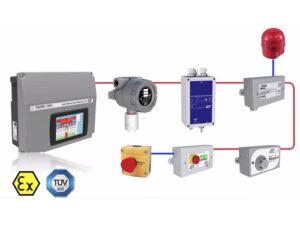
Our Revolutionary 2-Wire Addressable Gas Detection System
One Cable. Power and Communication Together.
Ideal for Systems up to 32 Detectors
Virtually No False Alarms
Watch the System in Action
Key Advantages of Our 2-Wire Addressable Gas Detection System
Fast and Simple Installation
One Two-Wire Cable Does Everything
Daisy-Chain Wiring
Supports Up to 128 Gas Detectors
Mix Different Detector Types
Automatic Device Recognition
Maintenance-Free Operation
Up to 80% Lower Installation Costs
Easy Future Expansion
Intelligent Local Control
SGT Portable Oxygen Detector
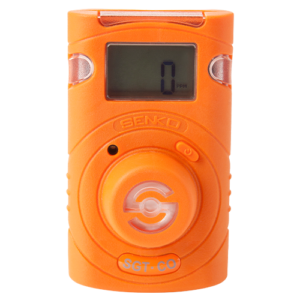
the SGT Portable Oxygen Detector provides triple alarm protection, ensuring workers are immediately alerted whenever hazardous oxygen levels are detected.
As soon as an oxygen deficiency occurs, the detector activates three independent alarm methods simultaneously:
- High-intensity flashing LEDs
- Built-in vibration alarm
- Powerful audible alarm
This triple-alert system ensures that workers receive the warning even in noisy environments or situations where one type of alarm might go unnoticed.
Available Gas Configurations
The SGT is available for monitoring a wide range of gases, including:
- Oxygen (O₂)
- Carbon Monoxide (CO)
- Hydrogen Sulfide (H₂S)
- Ammonia (NH₃)
- Hydrogen (H₂)
- Sulfur Dioxide (SO₂)
- Nitrogen Dioxide (NO₂)
Replaceable Sensor and Battery
Unlike many disposable single-gas detectors, the PDM+ features both a replaceable sensor and a replaceable battery.
This significantly extends the service life of the instrument, allowing it to remain in operation for many years while reducing long-term ownership costs.
Certified for Hazardous Locations
The detector is approved for use in explosive and hazardous environments and complies with internationally recognized certifications, including:
- ATEX
- IECEx
- INMETRO
These certifications make the PDM+ suitable for applications in the oil & gas, petrochemical, chemical processing, wastewater, mining, pharmaceutical, food processing, and other hazardous industrial environments.
Continuous Real-Time Monitoring
The SGT continuously measures the gas concentration in the worker’s breathing zone and displays real-time readings on a large, easy-to-read LCD screen.
This allows workers to instantly verify current gas levels while remaining protected throughout their shift.
Triple Alarm System
When hazardous gas concentrations are detected, the detector immediately activates:
- Audible alarm
- Strong vibration alarm
- Bright visual LED alarm
This multi-layer warning system maximizes worker awareness and helps ensure a rapid response to dangerous conditions.
Compact, Lightweight, and Comfortable
Weighing only 100 grams (3.5 oz), the PDM+ is extremely lightweight and comfortable to wear throughout an entire work shift.
Its compact size allows workers to move freely, even in confined spaces or demanding industrial environments.
Rugged IP67 Construction
The detector is designed for harsh industrial conditions and is protected against dust and water in accordance with the IP67 protection rating.
Simple One-Button Operation
The PDM+ is exceptionally easy to operate.
All major functions are controlled using a single button, making operation intuitive and minimizing training requirements.
Easy-to-Read LCD Display
The large LCD display clearly shows:
- Current gas concentration
- Alarm status
- Battery status
- Operating information
The bright display remains easy to read in a wide variety of working environments.
Technical Specifications
| Specification | Value |
|---|---|
| Dimensions | 5 × 9 × 3 cm |
| Weight | 100 g (3.5 oz) |
| Audible Alarm | 90 dB |
| Vibration Alarm | Integrated |
| Visual Alarm | Bright Red & Blue LEDs |
| Battery | Replaceable 3.6 V Lithium Battery |
| Certifications | ATEX, IECEx, INMETRO |
| Protection Rating | IP67 |
Did You Know?
Many people don’t realize that oxygen monitoring is one of the most critical functions of a 4-gas detector.
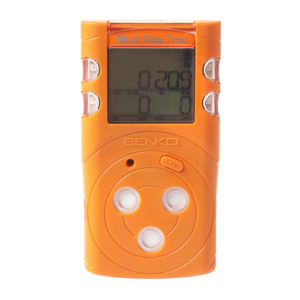
The MGT 4-Gas Detector, designed for confined space entry, includes a dedicated oxygen (O₂) sensor with a measurement range of 0–25% O₂.
This allows workers to continuously monitor oxygen levels before entering and while working inside confined spaces, helping to identify potentially life-threatening oxygen-deficient or oxygen-enriched atmospheres.
In addition to oxygen, the MGT simultaneously monitors three other critical hazards, making it an ideal solution for confined space applications where multiple gas risks may be present.
Typical gases monitored by the MGT include:
- Oxygen (O₂)
- Combustible gases (%LEL)
- Carbon Monoxide (CO)
- Hydrogen Sulfide (H₂S)
Continuous oxygen monitoring is essential because oxygen deficiency can occur without any visible warning signs, making reliable personal gas detection a critical part of every confined space safety program.
Process Oxygen Measurement
Step 3 – Measuring Oxygen in a Process
In many industrial applications, oxygen must be measured directly within a process rather than simply monitoring the ambient air in a room.
Examples include inerting systems, nitrogen blanketing, gas generation, heat treatment furnaces, pharmaceutical manufacturing, food packaging, semiconductor production, and many other industrial processes.
In these applications, oxygen concentrations can range anywhere from 0% to 100% oxygen, depending on the process requirements.
What Does Oxygen Above 23% Mean?
Many people assume that more oxygen is always safer.
In reality, the opposite can be true.
When oxygen concentration exceeds approximately 23%, the atmosphere is considered oxygen-enriched, creating a significantly increased fire and explosion hazard.
Why Is Oxygen Enrichment Dangerous?
Let’s revisit the well-known Fire Triangle, which consists of three elements:
- Oxygen
- Fuel
- Ignition source
When oxygen concentration increases above normal atmospheric levels (20.9%), many combustible materials ignite more easily and burn much more rapidly.
In an oxygen-enriched atmosphere:
- Less ignition energy is required to start a fire.
- Materials that normally burn slowly may ignite violently.
- Fires spread faster and are much more difficult to control.
- Certain gases and chemicals become significantly more hazardous.
Even a small spark that would normally be harmless may be sufficient to ignite combustible materials or flammable gases.
For this reason, monitoring oxygen enrichment is just as important as monitoring oxygen deficiency.
OMD-507 In-Line Oxygen Analyzer
The OMD-507 is a continuous in-line oxygen analyzer designed for accurate oxygen measurement in industrial processes.
Unlike portable or area monitors, the OMD-507 continuously samples the process stream and provides precise real-time oxygen measurements.
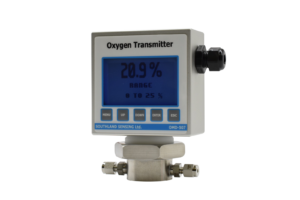
Multiple Measurement Ranges
The analyzer is available with measurement ranges suitable for virtually any oxygen monitoring application, including:
- PPM (trace oxygen)
- Percentage oxygen (%)
- Pure oxygen (100% O₂)
Automatic Auto-Range Function
The large LCD display supports an AUTO RANGE mode, allowing the analyzer to automatically switch between measurement ranges for optimum resolution and accuracy without operator intervention.
Advanced Galvanic Sensor Technology
At the heart of the OMD-507 is a proprietary Galvanic Electrochemical Fuel Cell sensor developed and manufactured by the manufacturer under strict quality standards.
This proven sensor technology provides:
- Excellent accuracy
- Fast response time
- Outstanding long-term stability
- Reliable continuous operation
Virtually Maintenance-Free
One of the major advantages of the OMD-507 is its extremely low maintenance requirements.
Unlike many traditional oxygen analyzers, the sensor:
- Requires no electrolyte replacement
- Requires no electrode cleaning
- Requires minimal routine maintenance
This significantly reduces downtime and maintenance costs.
Available Measurement Ranges
The OMD-507 is available in numerous measuring ranges, including:
Trace Oxygen (PPM)
- 0–10 ppm
- 0–100 ppm
- 0–1,000 ppm
Percentage Oxygen
- 0–1%
- 0–5%
- 0–10%
- 0–25%
- 0–100%
Pure Oxygen Applications
- 0–100% O₂
Communication and Output Options
The OMD-507 supports multiple industrial communication interfaces, making integration into existing control systems simple.
Available outputs include:
- 4–20 mA Analog Output
- 0–10 VDC Analog Output
- Modbus RTU / RS-485
- ASCII Communication
- Intrinsic Safety Zener Barrier Interface
These options allow seamless integration with PLCs, SCADA systems, Distributed Control Systems (DCS), Building Management Systems (BMS), and other industrial automation platforms.
The OMD-507 Continuous In-Line Oxygen Analyzer is an ideal solution for industrial process monitoring where accurate, reliable, and continuous oxygen measurement is essential for product quality, process control, and plant safety.
ATEX Oxygen Detector for Hazardous Areas
Many industrial facilities contain hazardous (explosive) areas where flammable gases, vapors, or dust may be present.
These areas are classified according to international hazardous area standards (such as Zone 0, Zone 1, and Zone 2 under the ATEX/IECEx system), and all electrical equipment installed within these locations must be explosion-proof or intrinsically safe.
The primary objective is to ensure that no electrical equipment can generate a spark or surface temperature capable of igniting a flammable atmosphere.
For this reason, gas detectors and all other electrical devices installed in hazardous areas must comply with stringent international certifications such as ATEX and IECEx.
TOC-903 ATEX/IECEX/DIV/ZONE Oxygen Detector
The TOC-903 is a fixed oxygen detector specifically designed for installation in hazardous locations.
Certified to ATEX requirements, it provides reliable continuous oxygen monitoring while meeting the highest safety standards for explosive environments.
Key Features
Certified for Hazardous Areas
Approved for installation in explosive atmospheres where conventional gas detectors cannot be safely used.
Long Sensor Life
The electrochemical oxygen sensor has an expected service life of more than five years, minimizing maintenance costs and reducing downtime.
Analog Output
- 4–20 mA analog output for direct connection to PLCs, DCS, SCADA systems, Building Management Systems (BMS), and other industrial control systems.
Dual Alarm Relays
The detector includes two dry-contact relay outputs, allowing independent activation of alarm functions such as:
- Low Oxygen Alarm
- High Oxygen Alarm
- External horn/strobe activation
- Ventilation control
- Emergency shutdown systems
Digital Display
A built-in digital display continuously shows the current oxygen concentration, allowing operators to verify gas levels at a glance.
Non-Intrusive Magnetic Programming
One of the TOC-903’s most valuable safety features is its non-intrusive programming capability.
Because opening electrical enclosures in hazardous areas is prohibited while energized, the detector can be fully configured without opening the enclosure.
Instead, programming is performed using a dedicated magnetic programming tool that operates through the display window.
This allows technicians to safely:
- Configure alarm setpoints
- Adjust operating parameters
- Perform calibration functions
- Navigate the detector menu
without compromising the explosion-proof integrity of the enclosure.
This design not only enhances safety but also simplifies routine maintenance and reduces service time in hazardous environments.

Do Oxygen Detectors Have an Expiration Date?
The answer is yes—or more accurately, the oxygen sensor does.
The lifespan of an oxygen detector is primarily determined by the life expectancy of its electrochemical sensor.
Most oxygen sensors currently available on the market have an average service life of up to two years, after which sensor replacement is typically required to maintain measurement accuracy and reliability.
Longer Sensor Life Means Lower Operating Costs
Our oxygen detectors are equipped with high-quality sensors designed to provide an expected service life of more than five years.
A longer-lasting sensor offers several important advantages:
- Lower maintenance costs
- Fewer sensor replacements
- Reduced system downtime
- Improved long-term reliability
- Lower total cost of ownership
For facilities operating multiple oxygen detectors, the extended sensor life can result in significant savings over the lifetime of the system.
Where Should an Oxygen Detector Be Installed?
An oxygen detector should be installed anywhere there is a potential for oxygen levels to decrease or increase beyond safe limits.
Typical applications include:
- Laboratories
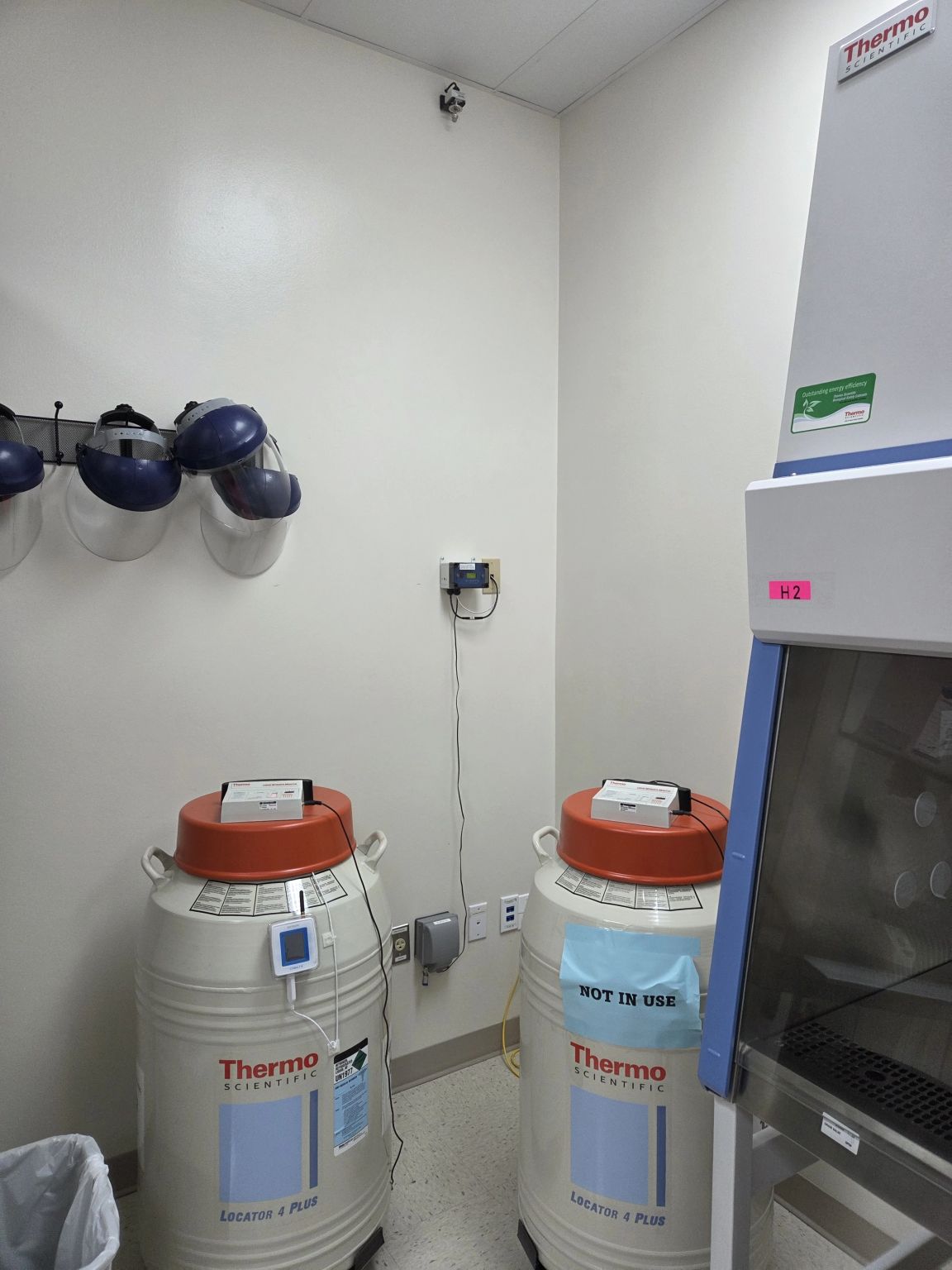
- Cryogenic liquid storage rooms (liquid nitrogen, liquid oxygen, liquid argon)
- Medical gas storage areas
- Nitrogen generation systems
- Oxygen enrichment systems
- Confined spaces
- Chemical processing plants
- Pharmaceutical manufacturing facilities
- Food and beverage processing plants
- Semiconductor manufacturing
- Industrial gas cylinder storage rooms
- Welding and cutting operations
- Controlled atmosphere processes
- Any enclosed space where inert gases or oxygen are used or stored
Before selecting an installation location, it is important to perform a hazard assessment to determine whether the primary risk is oxygen deficiency, oxygen enrichment, or both.
Proper detector placement is essential to ensure rapid detection and maximum personnel protection.
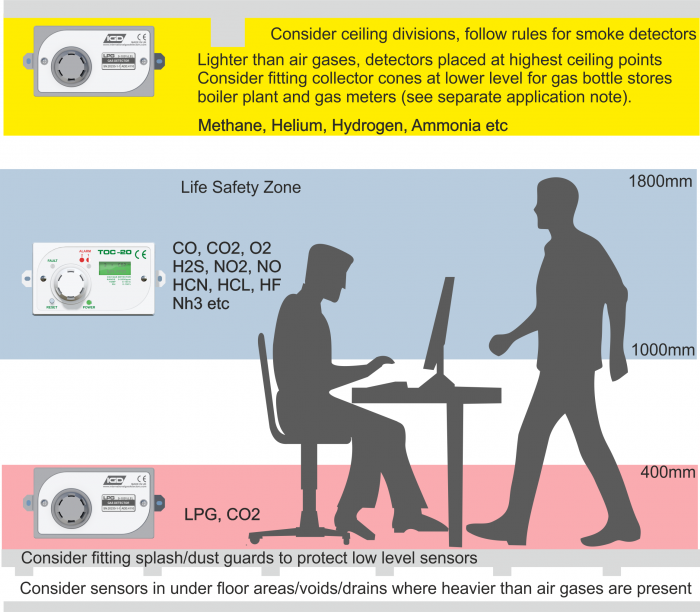
Recommended Gas Detector Installation Heights
The illustration below provides a useful reference for determining the correct installation height for different types of gas detectors.
Proper detector placement is critical for ensuring the fastest possible detection and maximizing personnel safety.
For example:
- LPG (Liquefied Petroleum Gas) and other gases that are heavier than air should be monitored with detectors installed approximately 20 cm (8 inches) above the floor, where the gas is most likely to accumulate.
- Oxygen detectors, on the other hand, should generally be installed within the breathing zone, approximately 1.0 to 1.8 meters (3.3 to 6 feet) above the floor. This allows the detector to monitor the air that personnel are actually breathing and provides the most representative measurement for worker safety.
Always consider the specific application, ventilation patterns, gas release source, and applicable local regulations when determining the final detector location. Proper installation is just as important as selecting the right detector, and it plays a crucial role in achieving reliable and timely gas detection.
Related Posts