Hydrogen Detection for Battery Rooms – It Doesn't Have to Be Complicated When people think…

What Does Your Morning Orange Juice Have to Do with Gas Detection?
What Does Your Morning Orange Juice Have to Do with Gas Detection?
Probably more than you think.
Orange juice may seem far removed from industrial gas detection, but its journey from production to your breakfast table provides an interesting example of why gas monitoring systems exist — and why proper testing and maintenance of those systems matter.

Large quantities of orange juice are transported from Brazil to the United States aboard specialized vessels equipped with refrigerated cargo tanks.
During transportation, maintaining product quality is important. One method used to help reduce oxidation is the use of nitrogen (N₂) to create a protective atmosphere and reduce exposure of the product to oxygen.
Nitrogen is extremely useful for this purpose, but it also introduces an important safety consideration.
Nitrogen Is Not Toxic — So Why Can It Be Dangerous?
Nitrogen already makes up approximately 78% of the air around us. It is not normally considered a toxic gas.
The danger occurs when additional nitrogen is released into an enclosed or poorly ventilated area.
Nitrogen can displace oxygen.
Because nitrogen is colorless and odorless, people cannot see, smell, or otherwise reliably recognize that the oxygen concentration around them is decreasing.
This is why nitrogen applications often require oxygen monitoring rather than nitrogen detection.
An oxygen detector continuously measures the percentage of oxygen in the surrounding atmosphere.
Under normal conditions, atmospheric oxygen is approximately 20.9% by volume.
If nitrogen is released and begins replacing the surrounding air, the oxygen concentration decreases. An oxygen detector can recognize this change and provide a warning before the atmosphere becomes dangerously oxygen-deficient.
What Does an Oxygen Detector Actually Measure?
This is an important distinction.
An oxygen detector installed in an area where nitrogen is used generally does not detect nitrogen itself.
It measures oxygen.
For example:
Normal atmosphere → approximately 20.9% O₂
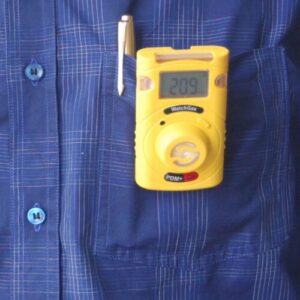
Nitrogen enters the area → oxygen concentration begins decreasing
O₂ detector senses the reduction → alarm activates at the configured alarm level
The detector is therefore providing an indirect indication that the atmosphere is changing.
A decreasing oxygen concentration should always be treated seriously, even if the exact cause is not immediately known.
Installing a Gas Detector Is Only the Beginning
One of the most important lessons in gas detection is that installing a detector does not mean the job is finished.
Gas detectors are measurement instruments.
Their sensors are exposed continuously to environmental conditions, contamination, humidity, temperature changes, vibration, sensor aging, and normal electronic drift.
Over time, sensor response can change.
A detector may still have power.
Its display may still show a value.
Its status light may still be green.
But none of those things alone prove that the sensor will respond correctly when a hazardous condition occurs.
That is why inspection, functional testing, and calibration are essential parts of a gas detection program.
Bump Test vs. Calibration — What’s the Difference?
These terms are sometimes used interchangeably, but they are not the same thing.
Bump Test
A bump test exposes the sensor to a known gas or condition to verify that the detector responds and that the associated alarms operate.
The basic question is:
“Does the detector respond when it should?”
Depending on the system, a functional test may also verify audible alarms, visual indicators, relays, controllers, remote alarms, or other connected safety functions.
Calibration
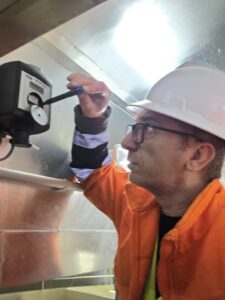
Calibration goes further.
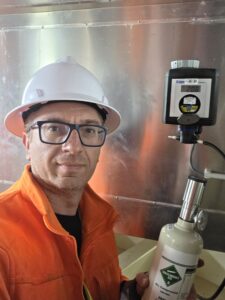
The detector is exposed to a known reference condition or certified calibration gas, and its indicated measurement is compared with the known value.
The basic question becomes:
“Is the detector measuring accurately?”
If necessary and permitted by the manufacturer, the instrument is adjusted so its response corresponds correctly to the reference value.
Both activities are important, but they verify different things.
What Should Be Checked During Routine Gas Detector Maintenance?
A good maintenance program should look beyond the number shown on the display.
Depending on the detector and application, routine inspection should include:
- Sensor response
- Measurement accuracy
- Zero reading
- Alarm operation
- Audible and visual indicators
- Sensor condition and remaining life
- Obstructions around the sensor
- Wiring and electrical connections
- Controller communication
- Relay operation
- Remote alarms or shutdown functions
- Calibration history
- Error or fault messages
- Environmental conditions around the detector
For portable detectors, battery condition, pump operation, filters, tubing, sample lines, and flow should also be checked where applicable.
Sensor Location Matters
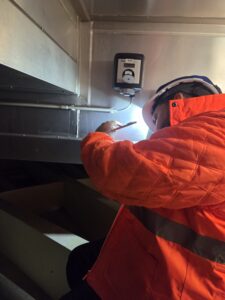
Even a perfectly calibrated detector cannot provide adequate protection if it is installed in the wrong location.
Detector placement should be based on the specific hazard and application.
Important considerations include:
- Where could the gas be released?
- Where are workers normally located?
- Is the area enclosed or well ventilated?
- How does air move through the space?
- Are there doors, exhaust fans, supply-air vents, or other sources of airflow?
- Could equipment or structures create areas where gas may accumulate?
- What gas or atmospheric condition are we trying to detect?
There is no universal mounting height that is correct for every gas detection application.
Detector placement should be determined through an understanding of the gas, the potential release points, ventilation, equipment layout, manufacturer guidance, and the actual purpose of the monitoring system.
Never Block the Sensor
This sounds obvious, but it is a common field issue.
A gas detector needs access to the surrounding atmosphere.
Paint, dust, dirt, plastic covers, equipment, storage materials, or other obstructions around the sensor can interfere with the movement of gas to the sensing element.
A detector should therefore be visually inspected regularly to make sure its sensing area remains accessible and unobstructed.
Understand What Your Detector Is Telling You
Operators should know more than simply where the detector is installed.
Anyone responsible for an area protected by gas detection should understand:
What gas or condition is being monitored?
What is the normal reading?
What are the alarm levels?
What does each alarm mean?
What should personnel do when an alarm occurs?
What does a fault indication mean?
When was the detector last tested or calibrated?
A gas detector is much more useful when the people working around it understand what the information means and how they are expected to respond.
Never Assume an Alarm Is Just a Bad Sensor
Occasional sensor faults and false alarms can occur.
But an unexpected gas reading or alarm should never automatically be dismissed as a detector problem.
The detector is installed for a reason.
The appropriate response is to follow the facility’s established safety procedures, determine whether the atmosphere is safe, and then investigate the cause of the alarm.
If the detector is suspected of malfunctioning, it should be properly tested.
Calibration Records Matter Too
Gas detection maintenance should be documented.
Useful records can include:
- Detector identification or tag number
- Location
- Gas being monitored
- Sensor type and range
- Alarm settings
- Date of inspection
- Date of calibration
- Calibration gas concentration
- Calibration gas lot number and expiration date
- As-found condition
- As-left condition
- Faults or deficiencies discovered
- Corrective actions
- Technician information
- Next scheduled service
Good records make it easier to identify recurring problems and understand the history of each detector.
A Real-World Example: Gas Detection Aboard an Orange Juice Vessel

Recently, I had the opportunity to test and calibrate gas detectors installed around the cargo tank areas of a specialized vessel used to transport orange juice.
It was an interesting reminder of how broad the world of gas detection really is.
The basic safety principle aboard a vessel is not fundamentally different from what we see in laboratories, wastewater facilities, manufacturing plants, food processing facilities, or other locations where nitrogen is used.
If a process can change the atmosphere around workers, that atmosphere may need to be monitored.
And if a gas detector is being relied upon for that monitoring, it needs to be properly selected, located, inspected, tested, calibrated, and maintained.
The Most Important Lesson
Gas detectors are often installed in places where we hope they will never have to warn us of a real emergency.
That makes maintenance easy to overlook.
But the fact that a detector hasn’t alarmed for months or years does not prove that it is working correctly.
A gas detector is a safety instrument.
Know what it measures.
Know what its alarms mean.
Keep the sensing area unobstructed.
Test its response.
Calibrate it according to the applicable manufacturer and facility requirements.
Document the results.
And most importantly, make sure the people who depend on the detector understand how to respond when it tells them something is wrong.
Gas detection can be found in some unexpected places.
Sometimes it’s protecting workers in a chemical plant.
Sometimes it’s monitoring the atmosphere in a wastewater facility.
And sometimes it’s quietly working behind something as ordinary as the orange juice you drink in the morning.
Related Posts