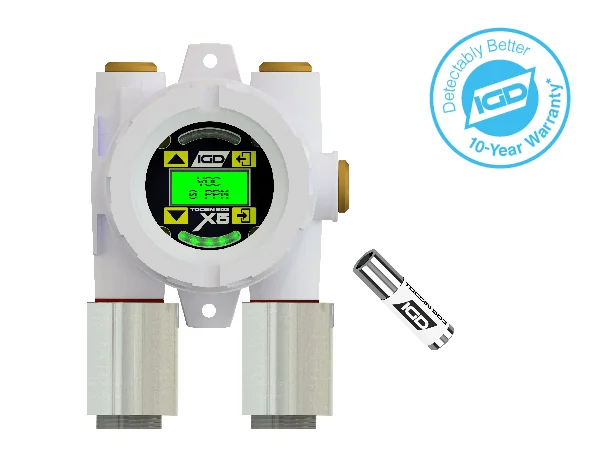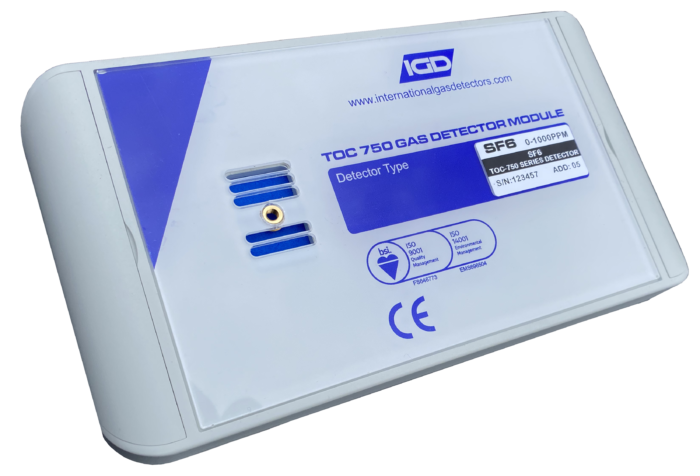
Hydrogen stand alone detector 750BAV-H2
Standalone Hydrogen Gas Detector (H₂) model 750BAV-H2
- Suitable for battery rooms
- Measurement range: 0–100% LEL
- Suitable for battery rooms, charging stations, forklifts, and hydrogen generators
- Longest sensor lifespan on the market: 5–10 years
- Built-in audible and visual alarms
- Water and dust resistant (IP54)
- Made in the UK
- Simple self-installation
- Supplied calibrated and ready for immediate use
Description
TOC-750BAV-H2
Standalone Hydrogen (H₂) Gas Detector with Audible & Visual Alarm
Product Overview
The TOC-750BAV-H2 is a fixed standalone hydrogen gas detector designed for continuous monitoring of hydrogen (H₂) in indoor safe-area applications.
The detector combines gas detection, local audible and visual alarm indication, reset functionality, and relay output in a single compact unit. This allows the detector to operate independently without requiring a dedicated gas detection control panel, while also allowing integration with ventilation systems, BMS, fire alarm interfaces, or other third-party control systems.
Key Features
- Continuous monitoring of Hydrogen (H₂)
- Standalone operation – no dedicated gas detection controller required
- Built-in audible alarm
- Built-in visual alarm indication
- Local Reset/Test functionality
- Relay output for external equipment or alarm signaling
- Can interface with ventilation/exhaust systems
- Can provide an alarm signal to BMS or third-party control systems
- Pre-calibrated sensor technology
- Replaceable sensor front for simplified maintenance
- Compact wall-mounted design
- IP54 enclosure
- Designed and manufactured in the United Kingdom
- TOC-750B series electronics covered by IGD’s 10-year warranty
Typical Technical Specifications
| Parameter | Specification |
|---|---|
| Model | TOC-750BAV-H2 |
| Target Gas | Hydrogen (H₂) |
| Application | Fixed continuous hydrogen monitoring |
| Detector Type | Standalone fixed gas detector |
| Alarm Indication | Integrated audible and visual alarm |
| Alarm Reset | Local reset functionality |
| Output | Relay output |
| Integration | BMS / third-party controller / ventilation control |
| Power Supply | 12–24 VDC |
| Ingress Protection | IP54 |
| Operating Temperature | 0°C to +55°C (32°F to 131°F) |
| Humidity | 0–95% RH, non-condensing |
| Mounting | Wall mounting; other mounting options available depending on application |
| Approx. Weight | 200 g |
| Sensor Replacement | Replaceable pre-calibrated sensor front |
| Country of Manufacture | United Kingdom |
Hydrogen Measurement
For battery-room safety applications, hydrogen can be monitored as a flammable gas hazard, typically expressed as a percentage of its Lower Explosive Limit (%LEL).
Typical configuration:
- Gas: Hydrogen (H₂)
- Measurement: %LEL
- Typical Range: 0–100% LEL
- Typical Alarm Level: 10% LEL
Alarm setpoints should be selected according to the applicable code, site risk assessment, ventilation design, and local regulatory requirements.
Battery Room Application
Hydrogen Safety in Battery Charging Areas
The TOC-750BAV-H2 is particularly suitable for battery rooms, battery charging areas, UPS battery rooms, and industrial battery charging applications where hydrogen may be generated.
Hydrogen can be released during the charging process of certain battery systems. Because hydrogen is highly flammable, accumulation in an enclosed or poorly ventilated space can create a potentially hazardous atmosphere.
Hydrogen is significantly lighter than air and naturally rises. Therefore, hydrogen detection should normally be positioned at high level, close to the ceiling or other locations where hydrogen could accumulate.
IGD specifically identifies battery storage, battery research, and battery charging facilities among applications for its hydrogen gas detection technology.
How the TOC-750BAV-H2 Protects a Battery Room
The detector continuously monitors the area for hydrogen accumulation.
When hydrogen reaches the configured alarm threshold, the TOC-750BAV-H2 can provide:
1. Local Audible Warning
The integrated sounder immediately provides an audible warning to personnel in or near the battery room.
2. Local Visual Warning
The integrated visual alarm provides clear indication that a hydrogen alarm condition has been detected.
3. Automatic Ventilation Activation
The detector’s relay output can be interfaced with a ventilation or exhaust system.
When the hydrogen concentration reaches the configured alarm level, the relay can be used to initiate ventilation and help remove accumulated hydrogen from the room.
4. BMS / External System Integration
The relay output can also provide an alarm signal to systems such as:
- Building Management System (BMS)
- Fire alarm interface
- External alarm panel
- Ventilation control panel
- PLC
- Other third-party control equipment
This allows the facility to receive and manage hydrogen alarms from a central monitoring location.
5. Standalone Protection
One of the primary advantages of the TOC-750BAV-H2 is that a separate gas detection controller is not necessarily required.
For a simple battery room application, the detector can provide:
Hydrogen Detection → Local Alarm → Relay Output → Ventilation / External Alarm
This makes the system particularly attractive for smaller battery rooms or installations where only one or a few hydrogen detection points are required.
Typical Battery Room Configuration
TOC-750BAV-H2 Detector
↓
Continuous H₂ Monitoring
↓
Hydrogen Alarm
↓
Built-in Audible + Visual Alarm
↓
Relay Output
↓
Ventilation / Exhaust Fan Activation
and/or
BMS / External Alarm Signal
Recommended Detector Location
Since hydrogen is much lighter than air, the detector should generally be installed:
- At high level
- Near the ceiling
- Above or near potential hydrogen release sources
- In areas where rising hydrogen may collect
- Away from locations where strong airflow could prevent representative detection
Final detector quantity and placement should be determined according to the battery-room layout, ceiling geometry, ventilation pattern, potential hydrogen release points, applicable standards, and a site-specific risk assessment.
Typical Applications
The TOC-750BAV-H2 can be considered for:
- Battery Rooms
- UPS Battery Rooms
- Battery Charging Rooms
- Forklift Battery Charging Areas
- Industrial Battery Charging Stations
- Energy Storage Facilities
- Battery Testing Facilities
- Battery Research Laboratories
- Hydrogen Generator Areas
- Hydrogen Equipment Rooms
- Other indoor locations where hydrogen accumulation may occur
System Advantages
The TOC-750BAV-H2 provides a simple and cost-effective approach to hydrogen safety because the essential functions are incorporated into one device:
Detection + Audible Alarm + Visual Alarm + Relay Output
This reduces the need for additional control equipment in simple applications and provides an effective solution for both local warning and automatic ventilation control.
For larger facilities, the relay output also allows the detector to become part of a broader BMS, alarm, or safety control system.
Summary
The TOC-750BAV-H2 Standalone Hydrogen Gas Detector provides continuous hydrogen monitoring with integrated audible and visual alarms and relay output capability.
For battery rooms, the detector can provide early warning of hydrogen accumulation and can be connected directly to ventilation or external monitoring systems. Its standalone design makes it particularly suitable for applications requiring a simple, reliable, and cost-effective hydrogen detection solution without a dedicated gas detection control panel.
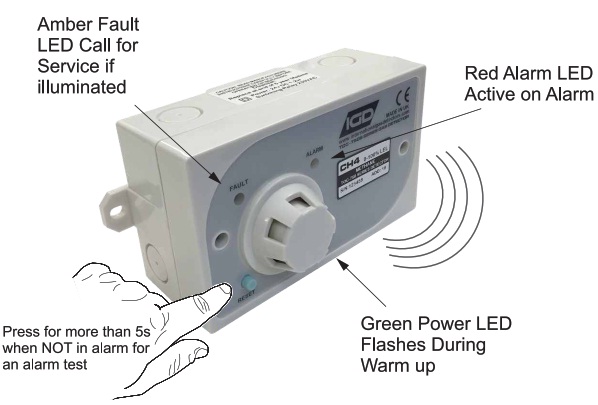
Detector Includes:
- Dry contact relay for alarm activation
- Built-in audible alarm
- LED indicators:
- Power
- Alarm
- Fault
- Built-in RESET button for alarm reset and silencing
- The button also functions as a TEST feature for detector verification
- إمكانية חיבור סירנה חיצונית עם מנורת אזהרה (Beacon) מחוץ לחדר בו מותקן הגלאי
Technical Specifications:
- Operating Voltage: 12–28 VDC
- Ambient Temperature: -10°C to +55°C
- Protection Rating: IP54
- Response Time: ~10 seconds
- Sensor Lifetime: 5–10 years
- Standards:
- EN50194-1:2009 (flammable gases)
- EN60335-1:2002
- EN50270
- Available Sensors: CO, CO₂, O₂, LPG, CH₄
- Outputs:
- Dry contact relay
- Digital output for external siren connection
- Alarm Level: 10% LEL
Installation Guidelines:
- Since hydrogen is lighter than air, the detector should be installed on the ceiling
- Install at least 1 meter away from ovens, transformers, and other emission sources