Optimizing Biogas Power Generation Through Accurate Gas Analysis Across the world, wastewater treatment plants and…
How to detect Ozone O3?
What Is Ozone Gas (O₃)?
Ozone (O₃) is a gas made up of three oxygen atoms. While it plays an essential role in protecting life on Earth, high concentrations of ozone at ground level can be harmful to people.
Ozone is a colorless gas with a distinctive, sharp odor. Exposure to elevated concentrations can irritate the eyes, nose, throat, and lungs, making continuous monitoring essential wherever ozone is produced or used.
In the upper atmosphere, ozone forms the Earth’s protective ozone layer, shielding us from harmful ultraviolet (UV) radiation. However, the same gas becomes a health hazard when it accumulates in enclosed workplaces.
How Is Ozone Produced?
Most industrial ozone generators produce ozone by exposing oxygen to ultraviolet (UV) light or by using corona discharge technology.
Because ozone is highly reactive, it is widely used for:
- Water treatment
- Air purification
- Surface disinfection
- Odor removal
- Food processing
- Medical sterilization
Although highly effective, ozone must be carefully monitored to ensure safe working conditions.
Where Can Ozone Leaks Occur?
Ozone monitoring is recommended anywhere ozone is generated, stored, or used, including:
- Swimming pools
- Paint and coating industries
- Water and wastewater treatment plants
- Cosmetic manufacturing
- Ozone generator rooms
- Hospitals and healthcare facilities
- Fish farms and aquaculture
- Paper and pulp manufacturing
- Food and beverage processing plants
- Air purification and sanitation systems
What Are the Occupational Exposure Limits?
According to the American Conference of Governmental Industrial Hygienists (ACGIH), the recommended occupational exposure limit for ozone depends on work intensity. For many industrial applications, the Threshold Limit Value – Time-Weighted Average (TLV-TWA) is commonly 0.1 ppm over an 8-hour workday, with additional short-term guidance depending on workload.
Always follow your local regulations and workplace safety requirements, as exposure limits may vary by country and application.
Using an Ozone Generator? Install an Ozone Detector.
If your facility uses an ozone generator, installing an ozone detector is one of the most important safety measures you can take.
A gas detector continuously monitors ozone concentration and immediately alerts personnel if unsafe levels are detected, helping prevent accidental exposure.
How Can Ozone Be Measured?
One of the simplest and most effective ways to measure ozone is with the UNI-O3 Portable Ozone Detector.
Compact, lightweight, and easy to operate, it is designed to protect workers wherever there is a risk of ozone exposure.
Key Features
- High-precision electrochemical ozone sensor
- Measurement range: 0–5 ppm
- Outstanding resolution of 0.01 ppm
- Alarm can be activated from as low as 0.01 ppm
- Compact size: approximately 5 × 5 cm
- Lightweight: only 100 g (3.5 oz)
- Triple alarm system:
- Loud audible alarm
- Bright visual LED alarm
- Strong vibration alert
A Common Application
One of the most common uses of a portable ozone detector is verifying that a room is safe to enter after ozone disinfection.
Many facilities use ozone to eliminate viruses, bacteria, mold, and odors. Before employees, contractors, or visitors re-enter the treated area, ozone concentrations should be checked to confirm they have returned to safe levels.
A portable ozone detector provides a fast, reliable, and accurate way to verify air quality and help protect everyone entering the space.
TOC-635-O3 Compact Ozone Monitoring System
Continuous Ozone Monitoring Made Simple
The TOC-635-O3 is a compact fixed ozone monitoring system designed to continuously measure ozone (O₃) levels and provide immediate warnings if concentrations become unsafe.
Compact, reliable, and easy to install, it is the ideal solution for facilities that use ozone for disinfection, air treatment, water treatment, or industrial processes.

Designed for Permanent Ozone Monitoring
The TOC-635-O3 is a compact fixed ozone monitoring system designed for continuous 24/7 protection in areas where ozone may be present.
It is ideal for installation in:
- Laboratories
- Manufacturing plants
- Industrial facilities
- Production areas
- Warehouses
- Water and wastewater treatment plants
- Hospitals
- Ozone generator rooms
- Any commercial or industrial facility where ozone is used or generated
Simple Installation – Only One Two-Wire Cable
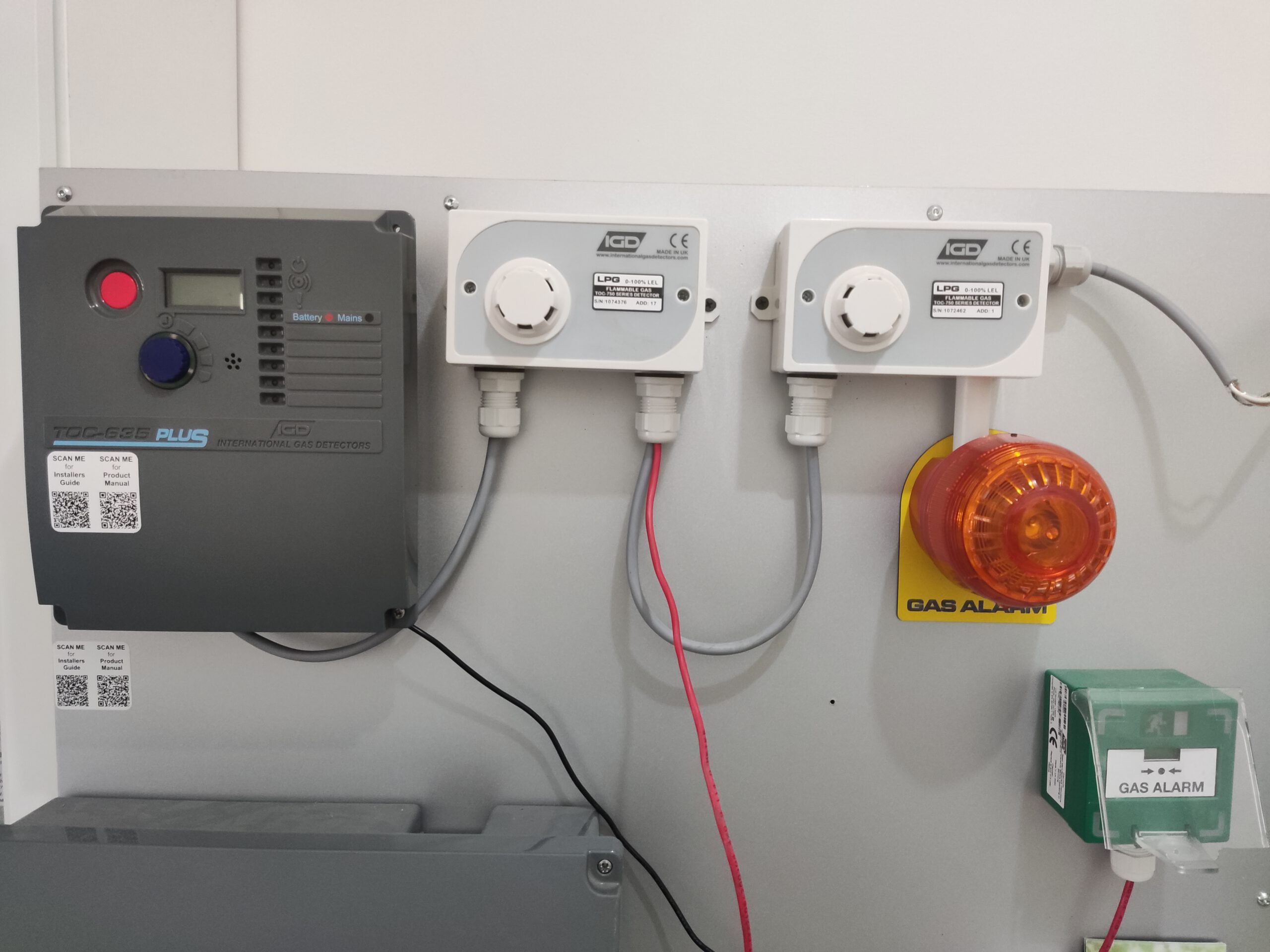
The system consists of a gas detection controller connected to one or more addressable ozone detectors.
Installation is fast and cost-effective because each detector requires only a single two-wire cable.
The same two wires provide both power and communication, eliminating the need for a separate power supply at every detector location. This reduces wiring, installation time, and overall project costs.
Daisy-Chain Wiring
Unlike conventional gas detection systems, each detector does not need to be wired individually back to the controller.
Instead, all ozone detectors are connected in a daisy-chain configuration, creating a cleaner installation while making future expansion quick and easy.
Instant Visual and Audible Alerts
The controller features a bright full-color digital display that continuously shows the system status.
If ozone levels exceed a preset alarm threshold, the display immediately changes to red, and a powerful built-in audible alarm is activated to warn personnel without delay.
Expand Your Safety System
The TOC-635-O3 can be equipped with a wide range of accessories, including:
- Flashing warning beacon with integrated siren
- Illuminated GAS ALARM sign
- Emergency break-glass call point
- Remote alarm indicators
- Ventilation control
- Building Management System (BMS) integration
- Additional programmable alarm outputs
These accessories allow the system to be customized for virtually any industrial or commercial application.
Reliable Protection Around the Clock
Combining intelligent addressable technology, simple two-wire installation, real-time monitoring, and flexible expansion options, the TOC-635-O3 provides dependable ozone detection and helps create a safer working environment—24 hours a day, 365 days a year.
TOC-30 Stand-Alone Ozone Detector
Simple, Reliable Continuous Ozone Monitoring
The TOC-30 is a compact stand-alone ozone detector designed for the continuous monitoring of ozone (O₃) levels in indoor environments.
It provides reliable, real-time ozone detection, making it an ideal solution for facilities where ozone is generated or used.
Key Features
- Continuous 24/7 ozone monitoring
- Designed for permanent indoor installation
- High-accuracy ozone detection
- Standard 4–20 mA analog output for easy integration with PLCs, Building Management Systems (BMS), and other monitoring equipment
- Quick and easy installation
- Compact, low-maintenance design
- Reliable long-term performance
- Manufactured in the United Kingdom
Typical Applications
The TOC-30 is ideal for:
- Ozone generator rooms
- Laboratories
- Water and wastewater treatment plants
- Food and beverage facilities
- Pharmaceutical manufacturing
- Hospitals and healthcare facilities
- Air purification systems
- Any industrial or commercial application requiring continuous ozone monitoring
The TOC-30 offers a simple, dependable, and cost-effective solution for protecting people and ensuring safe ozone levels in the workplace.
Frequently Asked Questions About Ozone Detectors
Where Should an Ozone Detector Be Installed?
Ozone detectors should be installed in every room where an ozone generator is operating.
If multiple ozone generators are installed in the same room and are more than 5 meters (16 feet) apart, additional detectors may be required to ensure complete coverage.
It is also recommended to install a detector near the room’s air return or ventilation intake, where ozone may accumulate or be carried by the airflow. The goal is to detect leaks as early as possible so that safety procedures can be implemented immediately.
At What Height Should an Ozone Detector Be Installed?
Although pure ozone is heavier than air, it mixes rapidly with the surrounding air due to normal room ventilation and air movement.
For most applications, ozone detectors should be installed approximately 60 cm (24 inches) above the floor unless a site-specific risk assessment recommends a different location.
Proper detector placement is critical for fast and reliable leak detection.
How Many Ozone Detectors Are Needed?
As a general guideline, one TOC-750-O3 Ozone Detector can monitor an area of approximately 75 m² (800 ft²) or a radius of about 5 meters (16 feet).
However, the exact number of detectors depends on several factors, including:
- Room size and layout
- Walls and partitions
- Number and location of ozone generators
- Ventilation and airflow patterns
- Ceiling height
- Applicable safety regulations
For the best level of protection, the detector layout should always be determined in consultation with the facility’s safety manager or a qualified gas detection specialist.
What Is a Bump Test?
A Bump Test is a quick functional check that verifies the detector is operating correctly.
During the test, the sensor is briefly exposed to a known concentration of ozone gas to confirm that it responds properly and activates its alarm.
Unlike calibration, a bump test does not adjust the detector. It simply confirms that the sensor, electronics, display, and alarm functions are working as expected.
How Often Should a Bump Test Be Performed?
As a minimum, a bump test should be performed once every month.
For applications where worker safety is critical, many facilities perform a bump test before each day’s use or prior to entering hazardous areas.
Frequent testing provides confidence that the detector will respond correctly during an actual ozone leak.
What Is Ozone Detector Calibration?
Calibration is the process of adjusting the detector to ensure it measures ozone accurately.
During calibration, the sensor is exposed to certified calibration gas with a known ozone concentration. The detector is then adjusted so that its readings and alarm points remain accurate and consistent.
Calibration should always be performed using certified calibration gas and by personnel who have been trained and authorized by the equipment manufacturer.
Proper calibration ensures reliable performance and compliance with safety requirements.
How Long Does an Ozone Sensor Last?
The typical service life of an electrochemical ozone sensor is approximately 24 months.
However, actual sensor life depends on several factors, including:
- Ozone concentration
- Frequency of exposure
- Temperature
- Humidity
- Overall environmental conditions
Regular bump testing and scheduled calibration help maximize sensor performance and ensure reliable protection throughout its service life.
Related Posts